
Newer advances have revolutionized cataract surgery at our centre. The skilled gentle hands of our experienced surgeon make your experience a remarkably painless & comfortable one. At Lobo Eye Clinic, we offer you the latest technology, combined with unparalleled surgical skill & experience.
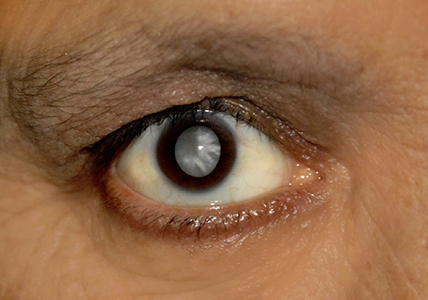
We have acquired the state-of-the-art Centurion Vision Phacoemulsification system from Alcon, USA. This uses the latest FMS & Ozil technology to take cataract surgery to a different level. Combined with the Moller Hi R Swiss microscope, the procedure now becomes even safer & more balanced. You deserve the best & we give it to you. A gentle & efficient system allows surgical removal of the cataract through micro incisions of 2.2 mm. (Micro Incision Cataract Surgery MICS) Only anesthetic drops are used (no painful injections near the eye) to ensure a comfortable & pain free experience. No bandage is necessary & protective clear glasses are needed only for a few days. Our patients just walk in & out of the operation theatre. (Our patients vouch for this. Read what they experienced).
Today’s cataract surgery can remove your dependence on glasses.
Aspheric, Toric, Trifocal, Multifocal & Extended Depth of field (EDOF) intraocular lenses are revolutionizing the way our patients see after cataract surgery. We offer detailed counseling of your condition & based on your specific needs offer what is best for you. You could experience a whole new world of vision after cataract surgery.
What is Cataract?
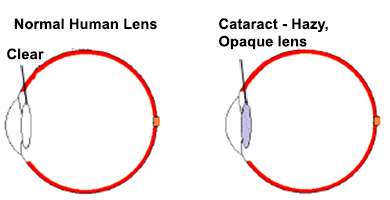
A Cataract is an opacity in the human lens. The human eye is similar to a camera. Any clouding of the eye's lens is called a Cataract. Cataract is not a new growth or film over the eye.
What causes cataracts?
Aging is the most common cause. Injury, Diabetes and some drugs like steroids are other common causes.
What are the symptoms of Cataract?
Gradual blurring, glare & smoky vision. Difficulty in reading small text in paper or mobile.
What is the treatment for Cataract?
There is no medical treatment. It is not possible to reverse or cure cataract with any medicines. Surgery is the only solution - having a success rate of over 98%.
Pain free Surgery
New advances in surgery, instrumentation & anaesthesia allow for pain free surgery. With no need for anaesthetic injection in most cases, complete anaesthesia is obtained just by use of drops. This leads to minimal discomfort during & after the operation.
What is an introcular lens?
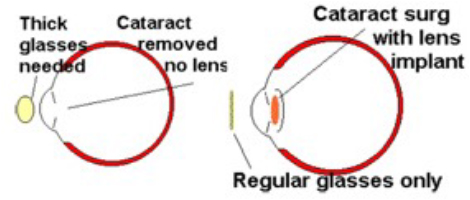
The cataractous lens, which has been removed at surgery, has to be replaced. This is done by an intraocular lens.
What are the ways of removing the Cataract?
Extra Capsular Surgery (stitches) :
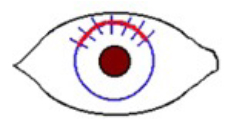 Extra Capsular Extraction (ECCE) is the older technique. It uses a large incision size of about 9-10 mm. Stitches are needed to close the incision. An injection is needed for anaesthesia.
Small Incision Cataract Surgery (SICS) :
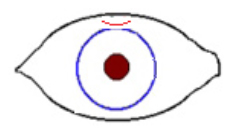 This technique uses a valved shaped incision of around 6 mm. Advantage is that stitches are not needed. Incision size is halfway between ECCE and Phacoemulsification. However, injection is usually needed for anaesthesia. Recovery time is shorter than ECCE but longer than Phacoemulsification.
Phacoemulsification :
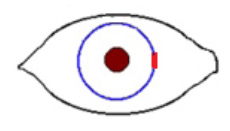 The latest and now standard technique is called Phacoemulsification (Phaco). The cataract is broken up inside up the eye with a narrow ultrasound needle and the pieces sucked out through a small incision of only 2.2 mm. Stitches are not necessary. Anaesthesia requires only drops and injection is not necessary. Healing is much faster and the technique is pain free, with quick return to normal activities.
FLACS – Femtosecond Laser Assisted Cataract Surgery :
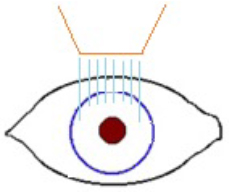 This technique uses a laser to assist in some parts of the cataract surgery, namely the incisions and the opening in the lens capsule. However, the main part of the surgery is completed with ultrasound phacoemulsification itself.
Opinion is still divided whether there are any real advantages over conventional phacoemulsification as the cost and surgical time increases greatly, without better results.
Advanced Cataract surgery at Lobo Eye Clinic :
Phacoemulsification (Phaco) technique has evolved further to offer greater safety and better results to our patients. We have proudly acquired the ultra sophisticated Centurion Vision System Phacoemulsifying instrument from Alcon, USA, with Ozil & Active FMS to ensure optimum safety, efficiency and the best possible results.
Centurion Vision System phacoemulsifying instrument :
A vastly superior phaco machine, Centurion Vision System Phacoemulsifier offers an unparallelled combination of safety and efficiency. With highly advanced controls and precise surgical programs, our use of the Centurion Vision System worldwide gives us much better surgical results.
Advanced Phaco, safer than standard Phaco :
Phacoemulsification process generates a lot of heat inside the eye which can be harmful. Earlier phaco machines could not control this heat. Advanced machines like Centurion Vision System significantly reduce the heat produced in the eye. This has resulted in much less discomfort & much faster & better postoperative recovery.
Improved Efficiency :
With highly advanced Pump and active Fluidics systems, there are much less pressure fluctuations in the eye so the Centurion Vision System scores over all other phaco units in terms of faster surgery & better safety.
Micro Incision Phaco - The Future :
Centurion Vision System is equipped with the facility of micro incision cataract surgery. 2.2 mm incision is now standard, using newer technologies & special lenses. This leads to faster healing, less pain, quicker return to normalcy, & better safety.
What are the types of Intraocular Lenses (IOL)?
There are two basic types of lenses.
Rigid lenses made of a hard acrylic plastic. A rigid lens needs an incision of at least 5.5 mm to be inserted. Because of the large incision required to insert these lenses they are hardly being used nowadays.
Soft foldable lenses made of soft acrylic. This type of IOL can be folded and easily implanted through the same 2.2 mm incision taken for cataract surgery, enhancing advantages of the smaller incision. Foldable IOLs, apart from smaller incision, offer other advantages like better material and more stable designs. There is much less pain, faster healing, quicker return to normal activities and greater safety.
There are four types of foldable lenses :
Monofocal Foldable IOL :
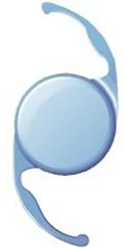 This type of IOL offers good distance vision. However patient requires glasses for near vision.
Toric Foldable IOL :
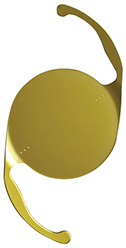 With Monofocal or Multifocal IOL, we correct spherical refractive error. Patients with pre-existing cylindrical refractive error would still have a residual number after surgery. The TORIC monofocal Intraocular Lens also corrects cylindrical number of a patient giving superior vision for distance and the toric multifocal IOL gives clear distance and near vision.
Multifocal or Trifocal Foldable IOL :
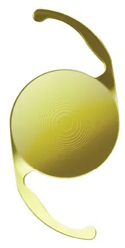 This type of IOL offers greater chance of freedom from glasses after cataract surgery. This lens maximizes the possibility of getting rid of spectacle number needed for distance as well as that for near. This IOL is a blend of highly sophisticated technology with precise design.
Extended Depth of Focus (EDOF) Lens:
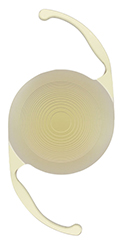 EDOF IOL gives good vision for distance and also for intermediate tasks on Laptop and mobile. Glasses are required only for fine print. Advantage over multifocals is less glare at night.
Cataract surgery has become a relatively routine and safe operation performed on lakhs of people each year. Resent advances in instrumentation and developments in intraocular lenses offer newer options restore vision. The best option for you will be determined after a full examination. if you have any questions please feel free to ask us.